
Aviation is often described by economists as the ultimate “capital-destroying” industry. Few businesses operate on margins as razor-thin, under conditions as volatile, as commercial airlines.
To understand why airlines constantly slip on the edge of bankruptcy, consider these structural traps:
Despite these brutal economics, India has grown into the third-largest domestic aviation market in the world. The story of how it got here starts with a single aviator’s license.
The story of India’s independent aviation begins on February 10, 1929, when Jehangir Ratanji Dadabhoy (J.R.D.) Tata (Chairman of Tata Group 1938 -1991) earned the first commercial pilot certificate issued in India, bearing Commercial License No. 1.
Three years later, on October 15, 1932, JRD Tata launched Tata Air Mail (later renamed Tata Air Lines). He personally piloted a single-engine de Havilland Puss Moth carrying 25 kg of mail from Karachi to Bombay (via Ahmedabad) before handing it over to RAF veteran Nevill Vintcent to fly onward to Madras.
In 1953, the Indian government passed the Air Corporations Act, nationalising the country’s nine operating airlines. This split civil aviation into two state-owned monopolies:
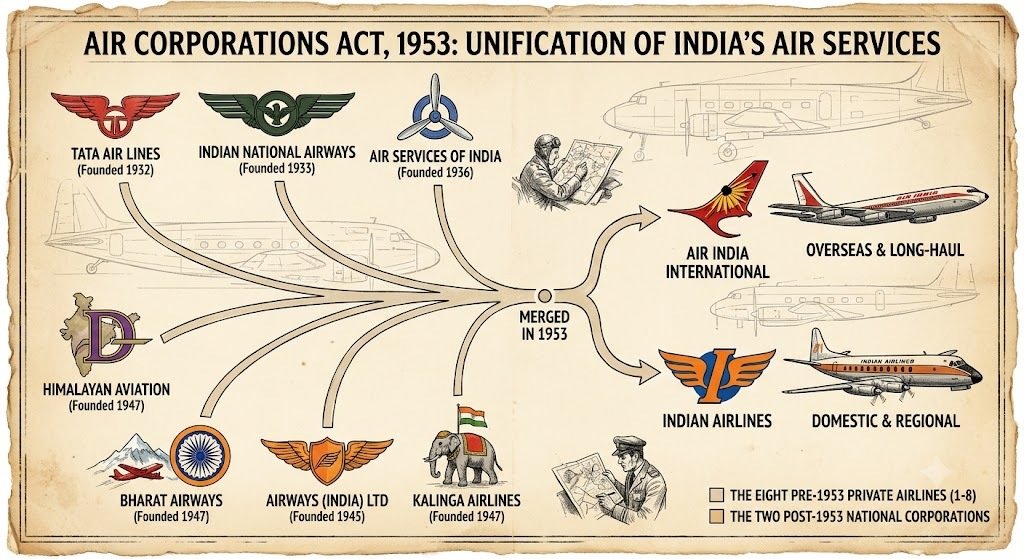
JRD Tata was appointed Chairman of Air India, a role he held for 25 years. Under his leadership, Air India became a global benchmark for luxury, introducing the iconic Maharajah mascot, fine porcelain, custom interior art, and world-class service. In 1960, Air India inducted its first Boeing 707, becoming the first Asian airline to enter the jet age.
By the 1980s, state monopoly began taking a toll on service quality and financial sustainability.
The economic liberalisation of 1991 altered Indian civil aviation through the introduction of the
Private operators were initially allowed to operate as “Air Taxi” services before full deregulation in 1994 repealed the Air Corporations Act.
The Survival of Jet Airways and Sahara
The 2000s democratised flying in India, transforming it from a luxury for the elite into everyday transport for a rising middle class.The Air Deccan Disruption
In 2003, Captain G.R. Gopinath launched Air Deccan, India’s first Low-Cost Carrier (LCC). By pioneering ₹1 fares, dynamic pricing, and point-to-point regional routes, Air Deccan forced traditional carriers to slash prices.
The High-Flying Launch (2005): Vijay Mallya launched Kingfisher Airlines as a luxury full-service carrier featuring brand-new aircraft, seatback entertainment, and gourmet food.
The Fatal Mistake: In 2007, Kingfisher bought Air Deccan to bypass the “5-year / 20-aircraft rule” required to fly international routes. Combining a ultra-luxury brand with a budget airline loaded Kingfisher with unsustainable debt. Coupled with the 2008 global financial crisis and high fuel costs, Kingfisher grounded operations in 2012.
Founded in 2006 by Rahul Bhatia and Rakesh Gangwal, IndiGo chose a disciplined execution model:
Single Aircraft Family (Airbus A320): Streamlined maintenance and pilot training costs.
Sale-and-Leaseback Model: Kept aircraft fleet ages under 6 years, minimising maintenance expenses.
Obsessive Focus: On-time performance, clean cabins, and transparent pricing.
In 2007, the Indian government merged Air India and Indian Airlines into a single entity (NACIL). The merger was plagued by cultural friction, incompatible IT integration, overlapping routes, and massive debt accrued from ordering 111 new aircraft. The national carrier entered a decade-long financial crisis reliant on taxpayer bailouts.
The decade between 2010 and 2020 exposed structural weaknesses in full-service models.
The Fall of Jet Airways (2019)
After 25 years of dominating international and domestic full-service travel, Jet Airways collapsed in April 2019 under $1.2 billion in debt. The overpaying acquisition of Air Sahara in 2007, aggressive competition from LCCs, and cash flow strain brought down India’s premier legacy carrier.
IndiGo’s Dominance & Structural Headwinds
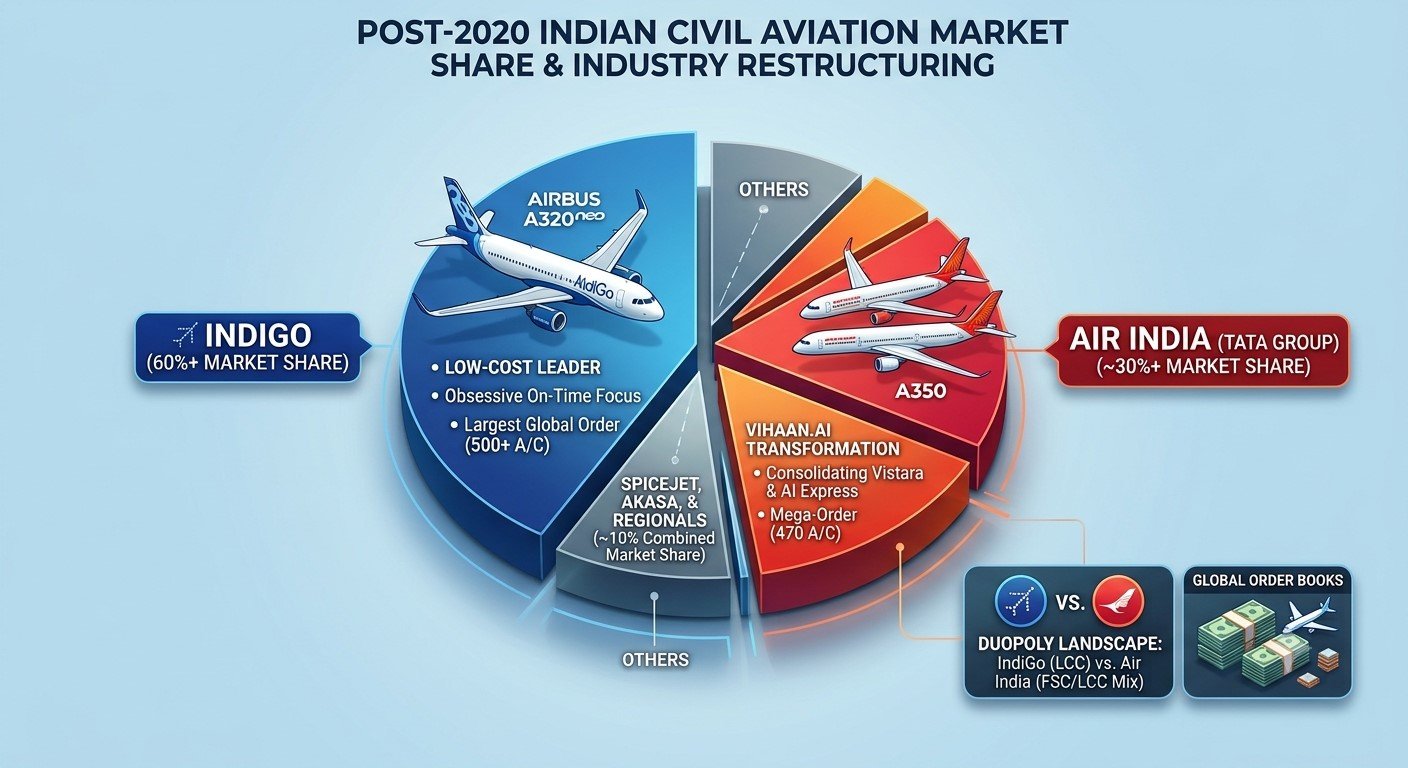
With Jet Airways gone and SpiceJet struggling with debt and grounded Boeing 737 MAX fleets, IndiGo captured over 50% of domestic market share. High state levies on fuel and airport charges meant that even market leaders operated on razor-thin profit margins.
The decade between 2010 and 2020 exposed structural weaknesses in full-service models.
After 25 years of dominating international and domestic full-service travel, Jet Airways collapsed in April 2019 under $1.2 billion in debt. The overpaying acquisition of Air Sahara in 2007, aggressive competition from LCCs, and cash flow strain brought down India’s premier legacy carrier.
With Jet Airways gone and SpiceJet struggling with debt and grounded Boeing 737 MAX fleets, IndiGo captured over 50% of domestic market share. High state levies on fuel and airport charges meant that even market leaders operated on razor-thin profit margins.
The post-COVID era marked a complete restructuring of the Indian aviation market.
In January 2022, Tata Sons officially re-acquired Air India for ₹18,000 crore, bringing the national carrier back home after 69 years under government management.
Under CEO Campbell Wilson, Air India launched Vihaan.AI, a 5-year transformation strategy structured into three phases:
While market forces drove the rise of LCCs and mega-mergers, the Indian government sought to democratize aviation from the top down. Launched in 2016 under the National Civil Aviation Policy (NCAP), UDAN (Ude Desh ka Aam Nagrik) aimed to fulfill a simple promise: make air travel affordable for the common citizen while linking unserved and underserved Tier-2, Tier-3, and Tier-4 regions.
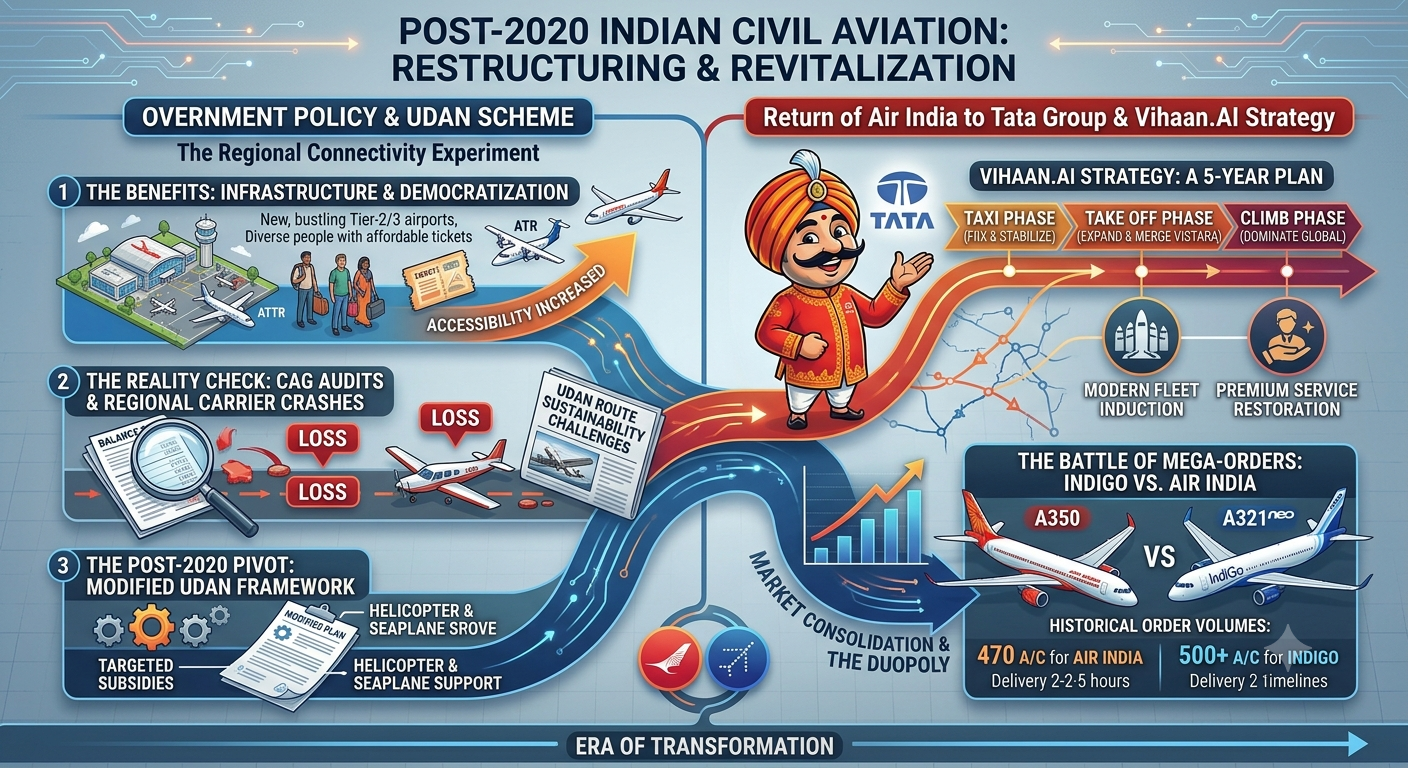
Despite its vision, UDAN highlighted the harsh economics of operating small-aircraft regional networks in India.
Recognizing these structural limitations, the Ministry of Civil Aviation shifted its strategy post-2020:
Now comes the real headline – who survives, grows and dominates the Airline market in India. To secure long-term delivery slots and capture growing international traffic:
|
Era |
Dominant Players |
Major Failure / Lesson |
|
1932–1950s |
Tata Air Lines / Air India |
State control restricted private agility |
|
1990s |
Jet Airways, East-West, Sahara |
Undercapitalised business models failed |
|
2000s |
Air Deccan, Kingfisher, IndiGo |
M&A mismatches (Kingfisher + Air Deccan) |
|
2010s |
IndiGo, SpiceJet, Jet Airways |
Full-service carriers failed to compete with LCC yields |
|
Post-2020 |
Air India (Tata), IndiGo |
Market structured as a stable Duopoly |