
Yet, in a move that seems to defy fundamental tech economics, Moonshot AI has made the radical decision to give the full weights of this massive reasoning engine away completely for free to the open-source community.
To a traditional business observer, this looks like corporate suicide. However, in reality, it is a high-stakes, hyper-calculated market capture strategy by this Chinese startup that is racing for the US AI ecosystem.
In the global AI race, venture-backed startups face a massive structural bottleneck. Silicon Valley giants like Google, Microsoft, and OpenAI possess bottomless corporate balance sheets and deeply entrenched enterprise sales forces that can lock down Fortune 500 contracts years in advance. Emerging AI companies simply cannot compete on traditional corporate sales grounds.
Instead, they deploy a digital Trojan Horse. By releasing a top-tier model out in the open, they achieve immediate, viral distribution across the global engineering ecosystem.
Crowdsourced Optimization: Thousands of independent developers, researchers, and hobbyists instantly begin stress-testing, optimization, and software integration for the model, essentially acting as an unpaid, hyper-efficient QA department.
Frictionless Ecosystem Building: When tools, applications, and corporate internal workflows are built on top of a specific open-source foundation, it becomes deeply sticky. Developers become fiercely loyal to the architecture they know best.
If the software is free, how does a startup survive its massive burn-rate? The answer lies in the massive operational divide between downloading a model and actually running it at scale.
While a 2.8-trillion-parameter model is free to download, the infrastructure required to host it, serve API requests, and handle high-throughput enterprise reasoning tasks is still incredibly complex and cost-prohibitive for the average business.
FREE OPEN-SOURCE DOWNLOAD > ( Developer Ecosystem Build ) > ENTERPRISE MONETIZATION GAUNTLET
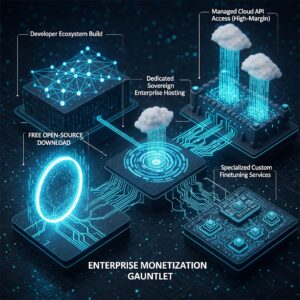
By leveraging massive funding rounds, such as Moonshot’s fresh capital injection, the strategy shifts away from selling proprietary software. Instead, it moves to selling high-margin cloud infrastructure, proprietary developer toolkits, and managed API access once a company has built its entire tech stack around that specific open-source core.
This open-source blitz isn’t just an aggressive play against Western frontier tech labs; it is a vital defensive shield within the hyper-competitive domestic ecosystem.
The Asian AI market has devolved into a ferocious, low-margin price war. Rivals like DeepSeek have consistently forced the industry’s hand by slashing API token pricing to near-zero levels.
For Moonshot AI, keeping their flagship technology closed-source behind a premium paywall would mean getting starved of developer mindshare. Releasing a massive open-weight model allows them to completely disrupt their competitors’ pricing strategies, forcing a shift in the corporate battlefield toward elite enterprise coding, advanced scientific reasoning, and high-margin knowledge work.
The strategy of giving away multi-million-dollar software for free proves that in the AI era, data and developer adoption are the ultimate currencies. The code itself is rapidly becoming a commodity; the true moat lies in the hardware efficiencies, local customization, and user ecosystems built right around it.
For startup operators and tech analysts, the Kimi K3 release serves as a powerful reminder: do not confuse a massive open-source giveaway with corporate charity. It is a highly calculated, aggressive play to own the foundational infrastructure of tomorrow’s software economy.