
On the afternoon of July 18, 2026, a rocket lifted off from India's First Launch Pad at Sriharikota after a 35-minute hold, climbed through the coastal haze, and settled into a 450-kilometre orbit about fifteen minutes later. The vehicle was Vikram-1, built by Hyderabad-based Skyroot Aerospace. It was the first privately developed Indian rocket to ever reach orbit, and it made India only the third country, after the United States and China, with a private company capable of doing the same. ISRO provided the launchpad, the motor-casting facilities, and safety oversight. Everything above the pad was private.
That single successful ascent is the moment this question stops being theoretical: can India build its own SpaceX? The honest answer is more interesting than a yes or no. India is not trying to clone SpaceX. It is running a different experiment, one built on state-backed liberalization rather than a lone billionaire's bet, and the early results say something real about what "Modi"nomics looks like when it is applied to a frontier industry.
Modi's Bet on Private Players
For most of India's history, space belonged entirely to the government. The Indian Space Research Organisation, ISRO, ran every satellite, every launch, and every contract. Private companies existed only as vendors, building parts to ISRO's specifications and handing them over. That model produced genuine engineering triumphs on famously tight budgets, including a Mars orbiter and a landing near the Moon's south pole, but it also meant no Indian company could build, own, or fly a rocket of its own.
That changed in May 2020, when the government opened space activity to private players for the first time.
Three reforms since then turned that announcement into an actual industry:
● IN-SPACe, a single-window regulator, was created to authorize private launches, hand out ISRO facility access, and cut through the licensing maze that used to make space activity a multi-ministry ordeal.
● The Indian Space Policy of 2023 set out the rules for who could do what, drawing a line between ISRO's role in research and strategic missions and the private sector's role in commercial launch, manufacturing, and satellite services.
● A liberalized FDI policy in 2024 allowed up to 100 percent automatic foreign investment in satellite components, 74 percent in satellite manufacturing, and 49 percent in launch vehicles and spaceports, alongside a ₹1,000-crore government venture fund routed through IN-SPACe.
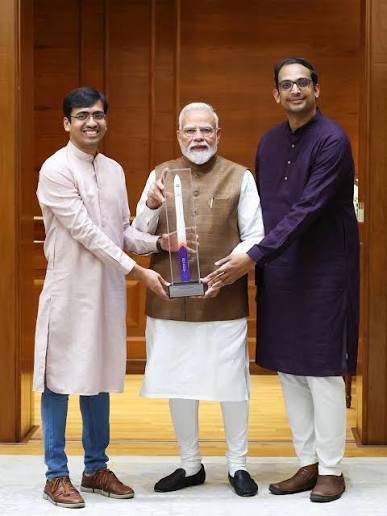
Prime Minister Narendra Modi has repeatedly framed this as his government's signature economic reform, not just a technology story. Inaugurating Skyroot's new Hyderabad campus in late 2025, he pointed to the more than 300 space startups now operating in India as evidence that opening the sector had done in six years what decades of a closed system could not.
Minister of State for Space Jitendra Singh went further, calling the 2020 opening the single greatest reform of the last eleven years of Indian governance.
"In the last six to seven years, India has transformed its space sector into an open, cooperative and innovation-driven ecosystem." — PM Narendra Modi, on the growth of India’s private space industry
Printing Rockets - Instead of Welding Them
Policy alone does not get a rocket to orbit. What makes Skyroot's story compelling as engineering, not just economics, is how it builds its engines. A conventional liquid rocket engine is forged and welded together from hundreds of separate parts, each one a potential failure point, each one adding cost and months of production time. Skyroot instead uses metal 3D printing, formally called Direct Metal Laser Sintering, to print engines as single, consolidated components.
The process works layer by layer. A bed of heat-resistant metal powder, typically a nickel or copper alloy, is spread thin, and a high-powered laser traces the shape of the engine into it, melting the powder into solid metal one slice at a time. Thousands of repetitions later, a combustion chamber, fuel injectors, and cooling channels emerge as one printed piece instead of an assembly of welded joints.
Raman: the precision workhorse
Named after Nobel laureate C.V. Raman, this engine powers the upper stage of Vikram-1 and handles the delicate job of placing satellites into precise orbits. Its hardest problem is heat: internal temperatures climb past 2,000°C, hot enough to melt the engine itself. Traditional designs solve this by wrapping cooling pipes around the outside of the nozzle by hand.
Skyroot instead prints microscopic cooling channels directly into the chamber walls, so the propellant absorbs heat as it flows through before it ever reaches combustion. Printing the injector head and combustion chamber as one piece, rather than welding hundreds of tiny nozzles together, cuts structural mass by roughly half and removes dozens of joints that could otherwise fail.
Dhawan: the cryogenic leap
Named after Dr. Satish Dhawan, this series is a fully 3D-printed cryogenic engine intended for Skyroot's heavier Vikram-2 vehicle. Cryogenic engines are notoriously hard to build because the same metal has to survive both the fire of combustion and propellant kept below minus 150°C without cracking. Dhawan burns liquefied natural gas, more than 90 percent methane, together with liquid oxygen, a cleaner and cheaper combination than the toxic hypergolic fuels older rockets relied on.
Its torch igniter and cryogenic valves are printed directly into the structure, which shortens the response time needed to restart the engine in the vacuum of space.The payoff, according to Skyroot, is speed: manufacturing timelines that once took months compress to days, with fewer joints and fewer places for a $60 million funding round to go wrong on the launchpad. That funding round, closed in May 2026 at a $1.1 billion valuation, made Skyroot India's first space unicorn, backed by Sherpalo Ventures, GIC, and funds tied to BlackRock.